2026 Outlook: SSD Storage is the New Frontier for AI Performance
By Solidigm AI Enablement Leadership
The evolution of artificial intelligence (AI) and high-performance computing has reached a critical inflection point. The relentless pursuit of GPU power continues, and storage solutions must keep up to address the unique challenges posed by increasingly advanced computing workloads.
However, the narrative has shifted. In next-generation systems, storage efficiency is now a defining factor in total system performance. From enhanced SSD architectures to the rise of liquid cooling technologies, advancements in storage throughout 2026 and beyond will redefine how data is accessed and managed.
To help navigate this transition, the Solidigm team has identified three key trends that are currently reshaping the AI data storage landscape.
png
As GPUs become more powerful, storage must become more efficient to balance lower power consumption with higher performance demands. “Power will be key,” said Hardeep Singh, Engineering Manager. “As GPU power rises, storage must become more efficient to maintain lower power with high performance.” This presents multifaceted storage challenges inside the server and across clusters.
Inside the server, storage performance will be the bottleneck as GPU power continues to increase for several reasons: the first is that modern accelerators are consuming data faster than traditional NVMe SSDs can deliver. Slowdowns will continue to emerge wherever the storage path can't keep pace with GPU data demands.
Solidigm AI Leaders shared that the challenge escalates across clusters: feeding thousands of GPUs requires large fleets of SSDs that deliver extreme parallelism, perfect wear-levelling under intense read-heavy AI workloads, and sustained performance without Quality of Service (QoS) drops.
Unfortunately, storage will not be the sole bottleneck; the scope, scale, and interaction with the host system will feel similar impacts. It will be crucial to ensure that internal and external networking can efficiently move data from storage to compute resources.
The answer to overcoming these challenges lies in the size and scale of storage solutions. Rather than focusing on single-drive speeds, solution-level enablement that can handle the demands of powerful GPUs is required. As noted above, storage efficiency, rather than compute power, will become the defining factor in system performance.
Speaking to the recently announced NVIDIA Inference Context Memory Storage Platform (ICMSP), Ace Stryker, Director of AI and Ecosystem Marketing, explained, “The growth of model training data has grabbed headlines for years, but the real explosion today is happening on the inference side of AI—driven by trends like RAG data and KV cache (a model’s context memory of user interactions).” NVIDIA’s announcement highlighted that fact, and Solidigm has the products, partnerships, and deep technical expertise to lead this transition, he added.
It’s become clear that managing everything in GPU memory is no longer possible and that high-performance SSDs are the answer.
Ace Stryker, Director of AI and Ecosystem Marketing
png
To support the massive throughput required for AI, SSDs are evolving from passive storage to active compute participants. We are seeing a fundamental shift in architecture, including:
Deep Parallelism: Controllers are being redesigned to service extreme random-read IOPS without the tail-latency spikes that stall AI training.
Streamlined Stacks: PCIe and NVMe stacks will become more streamlined to shave microseconds off the data path.
Smarter Firmware: Telemetry and data-placement algorithms now prefetch and stage data precisely where the GPU needs it.
Storage architectures will also evolve in how they leverage different aspects of SSDs. Scott Shadley, Director of Leadership Narrative and Evangelist, noted that SSDs have always delivered the latency performance required to meet the growing need for data, and migrating more resident data from other media, such as HDDs, to SSDs achieves the data availability required for real-time AI applications. Evolving into purpose-built AI drives, SSDs will act less like storage and more like high-bandwidth memory extensions.
png
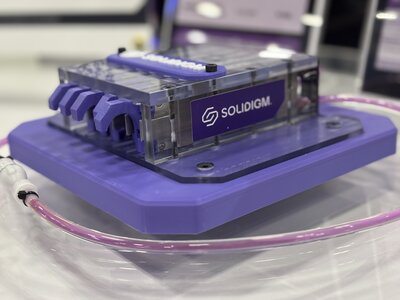
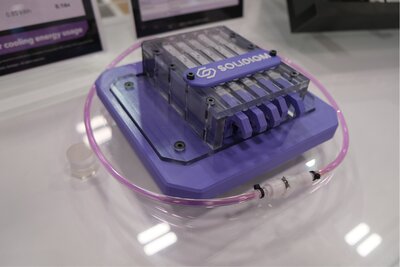
The most significant physical shift we foresee in 2026 is the transition to fanless, liquid-cooled server environments. As Roger Corell, Senior Director of AI and Leadership Marketing, explained, efficiently managing heat distribution in increasingly power-dense environments is critical, and liquid cooling is an order of magnitude more efficient than air at removing heat. For example, the Solidigm team, in collaboration with NVIDIA, led the effort to introduce the first liquid-cooled eSSD featuring single-sided cold-plate technology.
Key drivers of this shift include the removal of previously required fans when liquid cooling is used for GPUs/CPUs, and the inability of air cooling to meet future cooling demands as storage power and performance increase.
The adoption of liquid cooling removes a significant constraint in server design: the need for airflow. This enables SSDs to achieve a higher sustained performance while maintaining the same footprint as previously air-cooled solutions. “By removing heat far more efficiently than air, liquid cooling allows storage to keep pace with the thermal and density demands of next-gen AI systems,” said Avi Shetty, Senior Director, AI Market Enablement and Partnerships.
With fully liquid-cooled solutions, we can better optimize how systems are designed, unencumbered by the limitations of traditional fan-based cooling. This shift enables greater design freedom, with denser server designs that accelerate the transition from legacy form factors such as U.2 to EDSFF.
jpeg
jpeg
png
As we look toward the remainder of 2026 and beyond, it is clear that the compute-first era of AI has matured into a more balanced, holistic infrastructure model. The performance of a system is no longer measured solely by the trillions of operations a GPU can perform, but by how effectively that GPU is fed.
At Solidigm, our focus remains on pioneering the ideas and innovations that are reshaping what’s possible in AI data storage and beyond. We hope you will join us as we collectively move toward a future where storage is an active, intelligent participant in the AI workflow.
Solidigm is in St. Louis this week for SC25, sharing more on the company’s industry-leading efforts on eSSD liquid cooling with a demonstration on immersion cooling.
Leaders from CoreWeave, Dell, NVIDIA, and VAST Data joined Solidigm at the 2025 OCP Global Summit to push for relentless efficiency and redefine the AI innovation curve.
The introduction of the Solidigm D7-PS1010 E1.S SSD expands the high-performance D7-PS1010 family with a powerful, first-to-market eSSD equipped with single-sided, direct-to-chip liquid-cooling tec...